A high-profile champion show jumper is replaced by an absolute look-alike, but the switch isn't discovered for months.
Comfortable in the safe world of equine photography, ex-cop Kim Kovak thinks she has finally moved past the terror of a routine patrol that changed her life forever. Then a simple photo shoot catapults her into the middle of a cunning and dangerous ring of horse thieves. Old habits die hard and Kim goes after the truth with a vengeance.
Private investigator Garrett Quaid is determined to expose whoever is organizing a series of thefts where ringers are used and big insurance claims are paid. A quiet loner, Quaid doesn't welcome the meddling of one pushy photographer who always seems to be one jump ahead of him.
Together, and often at odds, Kovak and Quaid try to out-sleuth each other and, in the process, learn the chilling truth about the crimes.
Meet this dynamic duo in Double Exposure, available in October.
October 1, 2012


July 10, 2012
Writing Using the Five Senses
by Toni Leland
I have many passions: writing, music, photography, family, and gardening. In fact, my love of the outdoors and digging in the earth has served me well with my writing.
Passionate writing is something the world longs for, the driving force behind every book sale, or check-out at the library, or Internet download. To immerse oneself in the world of another is the salve for a troubled or weary mind.
So how do I relate my garden experience to my writing? Five senses—we all have them, we all use them—but do we employ them in our work? In the garden, these senses are obvious: seeing, hearing, smelling, touching, tasting. Each of them can be integrated into any work of fiction or non-fiction, enlarging the reader's view of your imaginary or real world.
Sight: from the whole of a garden landscape to the integral parts of a rose bed
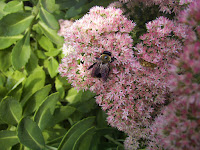 to the minute features of a dragonfly perched on a leaf, these details imprint our brain with an everlasting image. In your writing, incorporate details into the setting, gradually parceling it out over the first couple of chapters. Include how the first sight of something makes you feel. Refrain from spending two consecutive pages describing the scene; less at a time is better.
Sound: in spring, the woodland peeper frogs raise a din that stops one in their tracks. Bird conversations and song, the buzz of winged insects, the chatter of squirrels. In prose, find ways to liken your story sounds to something that brings an instant visual to the mind.
Smell: a Casa Blanca Lily fills the dusk air with a scent so heady that one must stop to inhale several times. Brush past a Scented Geranium and delight in the pungent mint, lemon, or musk fragrance that floats on the air and clings to your clothes. Including a sense of smell in your writing can be more challenging than some of the other senses.
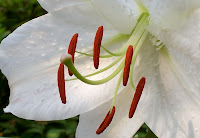
The word "smell" is both a verb and a noun: to smell a rose, or ask "what is that smell?" Use the word sparingly; others are more descriptive and appropriate: "fragrance" is used to convey something pleasant; "scent" can be pleasant or intriguing or mysterious. Add adjectives or adverbs to clarify the description; i.e., the heady fragrance; a manly scent. The word "odor" is almost without exception used to describe something unpleasant. You wouldn't say, "the odor of her perfume," but you would say, "the odor of the outhouse."
Touch: in my garden, I delight in the texture of soft, velvety Lambs Ears and the fernlike feel of a Japanese Laceleaf Maple. I'm careful to avoid the sting of thorns on the rosebushes and barberry, but love the feel of soft, warm earth sieving through my fingers. Touch is one of the easiest senses to convey in writing. Touch things in your environment or home, then write down the sensations they convey and liken them to something universally recognized. A soft chenille lap-robe might remind you of the fur on a rabbit or fluffy cat. Carrying the idea further, but without the hands-on research, consider the still, cold flesh of a dead body. Would it remind you of marble? Or wax?
Taste: ripe tomatoes warmed by the afternoon sun, or the tiny drop of nectar
 from a honeysuckle blossom, or the burst of heat from a spearmint leaf. Including taste in your writing is probably one of the toughest challenges unless you are writing about food or intimacy (clearly, no one tastes a piano or automobile), but see if you can find ways to incorporate this sense into your story. Describe how a kiss tastes, or a sip of wine, or a drink of water fresh from a mountain spring, or a crunchy apple, or a bit of grit on your tongue. Describe not only the physical sensation of the flavor, but the mental sensation the taste evokes.
Writing Prompt: Randomly choose any object, then apply all five senses and write a description of each. With a little practice, you can integrate the five senses into your writing.
I have many passions: writing, music, photography, family, and gardening. In fact, my love of the outdoors and digging in the earth has served me well with my writing.
Passionate writing is something the world longs for, the driving force behind every book sale, or check-out at the library, or Internet download. To immerse oneself in the world of another is the salve for a troubled or weary mind.
So how do I relate my garden experience to my writing? Five senses—we all have them, we all use them—but do we employ them in our work? In the garden, these senses are obvious: seeing, hearing, smelling, touching, tasting. Each of them can be integrated into any work of fiction or non-fiction, enlarging the reader's view of your imaginary or real world.
Sight: from the whole of a garden landscape to the integral parts of a rose bed

Sound: in spring, the woodland peeper frogs raise a din that stops one in their tracks. Bird conversations and song, the buzz of winged insects, the chatter of squirrels. In prose, find ways to liken your story sounds to something that brings an instant visual to the mind.
Smell: a Casa Blanca Lily fills the dusk air with a scent so heady that one must stop to inhale several times. Brush past a Scented Geranium and delight in the pungent mint, lemon, or musk fragrance that floats on the air and clings to your clothes. Including a sense of smell in your writing can be more challenging than some of the other senses.

The word "smell" is both a verb and a noun: to smell a rose, or ask "what is that smell?" Use the word sparingly; others are more descriptive and appropriate: "fragrance" is used to convey something pleasant; "scent" can be pleasant or intriguing or mysterious. Add adjectives or adverbs to clarify the description; i.e., the heady fragrance; a manly scent. The word "odor" is almost without exception used to describe something unpleasant. You wouldn't say, "the odor of her perfume," but you would say, "the odor of the outhouse."
Touch: in my garden, I delight in the texture of soft, velvety Lambs Ears and the fernlike feel of a Japanese Laceleaf Maple. I'm careful to avoid the sting of thorns on the rosebushes and barberry, but love the feel of soft, warm earth sieving through my fingers. Touch is one of the easiest senses to convey in writing. Touch things in your environment or home, then write down the sensations they convey and liken them to something universally recognized. A soft chenille lap-robe might remind you of the fur on a rabbit or fluffy cat. Carrying the idea further, but without the hands-on research, consider the still, cold flesh of a dead body. Would it remind you of marble? Or wax?
Taste: ripe tomatoes warmed by the afternoon sun, or the tiny drop of nectar

Writing Prompt: Randomly choose any object, then apply all five senses and write a description of each. With a little practice, you can integrate the five senses into your writing.
Subscribe to:
Posts (Atom)