A peculiar thing happens to writers. Not immediately, you understand. But as we learn our craft and smooth the rough spots, the rhythms of writing start to become second nature. Then, suddenly, we find ourselves unable to read fiction or watch a movie without applying every tidbit we've gleaned from myriad how-to books, magazine articles, workshops, and conferences.
This may not seem like a big thing, but for me, the phenomenon comes close to obsessive. Imagine a family member's reaction when I groan about a story I'm reading: "Why did the author do that? It's not in character!" Or I turn and smile knowingly at my husband: "Did you see the way the screenwriter used foreshadowing?" or "Right there--that was the second turning point!" He just shakes his head.
But this new awareness is not a bad thing. The very fact that we as writers recognize the structure, symbolism, and end intent of another's work proves that we are growing--absorbing the sweat equity of those who have clawed their way to the top of the cliff and hoisted themselves over. A reward, if you will.
Every craft has its weirdness, and it takes a certain amount of "hermit-ness" to stay the course. But behind the drive to become published, a thought hovers in the back of every writer's mind as he or she reads a bestseller or watches a great movie--I can do this.
©2018 Toni Leland
Showing posts with label Toni Leland. Show all posts
Showing posts with label Toni Leland. Show all posts
February 21, 2018


February 19, 2018
Don't be Boring Just to Make Word Count
A few years ago, I had a great Skype session with my almost-13-year-old
granddaughter, who was an avid reader and a great help to me with my Young Adult WIP, Tattoo, The Awakening.
Anyway, she asked what the next few scenes would be and
I mentioned that my main character would be taking a trip to another state. She nodded,
then leaned forward so I could see her expression on the screen.
"Well, okay, but leave out the boring stuff."
This caught me off guard. What would a young teen find
boring about a trip? So I asked her, and she didn't hesitate at all.
"You know, sitting in the plane, taking off, all that
stuff. If you use the plane trip, make it exciting. Like, if the plane crashes
and she's the only survivor!"
Okay, I can see that this child will not be fooled by
filler. And if she isn't, then neither will the thousands of other young
readers we hope to woo with our tales.
So, back to boring. In the early stages of my
fiction-writing career, I attended a workshop given by a successful writer in which
she outlined the parts of a novel and their importance. She focused on the
"sagging middle" because that's where many authors have problems. She
talked about breaking up the story into mostly equal word counts to achieve the
final goal, and how to dole out the story points through the whole thing.
Could I keep my mouth shut? Nope. During Q&A, I
mentioned that my story was finished, but I only had 65,000 words and the
required count was 85,000. How could I fix it? Without missing a beat, she
said, "Come up with more story." It was the right answer, but what
she didn't include was HOW to do that. I had to learn that on my own.
A story arc has three "acts" made up of scenes.
Each scene should tell the reader something new and move the story forward
smoothly. A story outline can give the author a map to follow and, like a road
trip, should include some scenery and attractions along the way. Building the
story world is one way to expand word count, but add too much and you'll have
readers skipping through the narrative. Extensive character description can
also expand word count, but most readers prefer to visualize a character
themselves rather than read about the mundane physical details. Dialogue is one
of the best writing techniques for carrying a story, but make every word
golden. Lots of dialogue is good and provides plenty of white space on the page
that gives one the feeling of reading quickly. But dialogue that tracks every
reply and grunt and "Hi" and "Yeah" and "Fine, how are
you?" is boring! We write stories not about real life as it boringly is,
but real life as it is interesting. Conflict is the foundation of every story,
so use it to the fullest.
Know ahead of time what your genre expects for word
count and include it in your initial story plan. I recently found this great explanation of word counts; it will make life much easier for me in the future
and I hope for you too.
To figure out how to achieve your desired word count, look
at each scene or plot point and ask yourself, "What else can happen to
make this more interesting?" This is how you "come up with more
story."
Now, about that plane crash...
February 14, 2018
Feeding the Writer's Muse
Writing is hard work! (No one believes that but other writers.) One of the things that commonly happens to those of us who spend hundreds of hours at our computers is we either 1) forget to eat, or 2) resent having to stop to eat, or worse—cook. Sounds harmless, but feeding the brain is a very important part of writing.
Feeding the Muse
The brain requires a steady supply of glucose (carbohydrate) in order to function correctly. In fact, the brain uses twice the energy of any other cell in your body and can only utilize carbohydrate to generate that energy. Now, I'm not talking about a steady diet of chocolate or potato chips (although the chocolate sounds like a good plan to me), but a writer must not fall into the habit of not eating because they are on deadline or on a roll. Conversely, too much sugar can cause brain fatigue. Avoid sweet soft drinks, pastries, cookies, and candy among others.
I keep snack foods in a drawer near my desk for those times when I,m hungry, but don't want to stop what I'm doing. Snacks that provide the mental energy without the calorie load include dried fruit (apricots, cranberries, raisins, etc.), nuts (walnuts and almonds), and easy to eat fresh fruit (blueberries, cherries, grapes, etc.).
Another cause of brain fatigue is dehydration. Again, who wants to leave their work to go get a drink of water? I keep a small bottle of water at hand, and try to drink at least 8 cups of water per day. Other beverages that will hydrate but not overload your brain with sugar include caffeine-free tea and fruit juice.
Plot With Your Crockpot!
The brain requires a steady supply of glucose (carbohydrate) in order to function correctly. In fact, the brain uses twice the energy of any other cell in your body and can only utilize carbohydrate to generate that energy. Now, I'm not talking about a steady diet of chocolate or potato chips (although the chocolate sounds like a good plan to me), but a writer must not fall into the habit of not eating because they are on deadline or on a roll. Conversely, too much sugar can cause brain fatigue. Avoid sweet soft drinks, pastries, cookies, and candy among others.
I keep snack foods in a drawer near my desk for those times when I,m hungry, but don't want to stop what I'm doing. Snacks that provide the mental energy without the calorie load include dried fruit (apricots, cranberries, raisins, etc.), nuts (walnuts and almonds), and easy to eat fresh fruit (blueberries, cherries, grapes, etc.).
Another cause of brain fatigue is dehydration. Again, who wants to leave their work to go get a drink of water? I keep a small bottle of water at hand, and try to drink at least 8 cups of water per day. Other beverages that will hydrate but not overload your brain with sugar include caffeine-free tea and fruit juice.
Plot With Your Crockpot!
As far as I'm concerned, my crockpot is my best friend. With just the tiniest bit of planning, I can sit down to a delicious dinner at the end of the day without having interrupted my work flow. On any given day, I write at least one blog post, one gardening article, text for my websites, begin or finish a feature article or column. I love not having to think about food!
For those who are away from home during the day, set up the crockpot in the morning or the night before, plug it into a timer so it will come on and turn off at the correct hour. You'll have a nice meal waiting for you, and can get on with your writing on a full tummy.
Here's one of my favorite crockpot recipes.
Pork Ragout with Fruit
Serves 8
Ragout is simply a fancy name for stew! You can substitute chicken, but be sure to use dark meat only. Breast meat will dry out during the long cooking time.
4 lbs bone-in pork shoulder or finger ribs
1/2 tsp salt
freshly ground pepper to taste
1 cup chopped onion
1 tsp ground ginger (or 2 tsp fresh grated)
1 Tbs brown sugar
1/4 cup red-wine or sherry vinegar (cider works just as well)
1 tsp dried thyme (or 1 Tbs minced fresh)
1 can reduced sodium beef broth (or 1 bouillon cube + 1 cup water)
1 cup whole dried apricots or peaches
1 cup dried cranberries (I use Craisins) or cherries or even prunes
1 cup dry sherry (or orange juice)
2 Tbs water
2 tsp cornstarch
Arrange onion in bottom of crockpot. Add meat, then season with salt, pepper, ginger, brown sugar, and thyme. Add vinegar, broth, sherry or juice, and fruit.
Cover and set to low. Cook 4 to 6 hours, depending on your experience with your own crockpot. Before serving, thicken liquid with cornstarch/water.
This dish is perfect served in a bowl or, if you feel like serving it over rice, it's fabulous that way too!
Other super-easy and delicious crockpot meals include Mac & Cheese and Simple Chicken. Google recipes that are one step meals–who has time to brown meat and fry onions and pre-cook stuff to go into the crockpot!
2018 Toni Leland
For those who are away from home during the day, set up the crockpot in the morning or the night before, plug it into a timer so it will come on and turn off at the correct hour. You'll have a nice meal waiting for you, and can get on with your writing on a full tummy.
Here's one of my favorite crockpot recipes.
Pork Ragout with Fruit
Serves 8
Ragout is simply a fancy name for stew! You can substitute chicken, but be sure to use dark meat only. Breast meat will dry out during the long cooking time.
4 lbs bone-in pork shoulder or finger ribs
1/2 tsp salt
freshly ground pepper to taste
1 cup chopped onion
1 tsp ground ginger (or 2 tsp fresh grated)
1 Tbs brown sugar
1/4 cup red-wine or sherry vinegar (cider works just as well)
1 tsp dried thyme (or 1 Tbs minced fresh)
1 can reduced sodium beef broth (or 1 bouillon cube + 1 cup water)
1 cup whole dried apricots or peaches
1 cup dried cranberries (I use Craisins) or cherries or even prunes
1 cup dry sherry (or orange juice)
2 Tbs water
2 tsp cornstarch
Arrange onion in bottom of crockpot. Add meat, then season with salt, pepper, ginger, brown sugar, and thyme. Add vinegar, broth, sherry or juice, and fruit.
Cover and set to low. Cook 4 to 6 hours, depending on your experience with your own crockpot. Before serving, thicken liquid with cornstarch/water.
This dish is perfect served in a bowl or, if you feel like serving it over rice, it's fabulous that way too!
Other super-easy and delicious crockpot meals include Mac & Cheese and Simple Chicken. Google recipes that are one step meals–who has time to brown meat and fry onions and pre-cook stuff to go into the crockpot!
2018 Toni Leland
February 12, 2018
Why Do I Write Horse Fiction?
My name is Toni Leland and I’m a horse addict.
Seriously...I could have been the poster child for the classic horse-crazy girl.
I discovered horses when I was about 7 years old. Unfortunately, about the same time, I discovered that my father was terrified of them and that there wouldn’t be a horse in my future any time soon.
So to fuel my passion, I hooked up with another horse-crazy girl. We spent hours talking about horses, dreaming about horses, pretending we were horses. . .the boys on the playground were terrified of us!
I took it one step further and wrote stories about horses. Girl rescues horse. Horse rescues girl. Horse and girl have an adventure. . . I wish I had some of those stories now!
He relented the year I turned 12 and, from then on, my life revolved around horses—sometimes more, sometimes less.
But one thing remained constant. To this day, even though I no longer have horses of my own, I still get that quickening in the pit of my stomach any time I’m near one.
Write what you know and love. The writing experts have it nailed.
When I set off on this journey of writing fiction, I naturally settled into the comfort zone of my addiction.
My first book was a romantic mystery, built around the Arabian horses I raised in the 80s. Though they were long gone, I held them near to me as we worked our way through the story and revisited characters from those years in the “horse business.” The process was sometimes painful and poignant, but it was also energizing. I’d found my niche.
As Winning Ways finished, I was already well into my next novel. Being fairly adventurous, I’d decided to see if I could write a straight romance—follow the formula, but write one with a horsey setting.
I was a little skeptical about the endeavor. After all, when does a busy horse owner have time to date, let alone nurture a strong, loving relationship? And into what niche would an equestrian romance fit?
When Hearts Over Fences hit the streets, I quickly learned that I had no clue as to “what works.” The book exploded in popularity and today it is still selling in both print and ebook.
So you’d think I’d jump on this gravy train, right? Nooooo. I was already off on another tangent. I wanted to write a thriller about the possibility of terrorism in one’s own backyard, er. . . barn. After Gambling With the Enemy was published in 2006, I headed back toward romantic suspense.
Deadly Heritage embraced that age-old theme of love lost and found. But my characters were constantly challenged by danger and family treachery.
As the nation’s economy nose-dived in 2009, so did business. Horse farms and breeders were deeply affected as the cost of keeping animals skyrocketed. If you can’t feed ’em, what do you do with them?
Horse rescue operations were overwhelmed and the horror stories began to hit the news.
Addressing two similar subjects, I began work on Rescue Me, the story of a horsewoman trapped in a brutally abusive marriage. The research alone on this book made me ever thankful that I didn’t have answers from first-hand experience.
Always a fan of Dick Francis, I began thinking seriously about a mystery series. What I needed was a couple of independent, horse-loving individuals who would save the horse world, case by case. Never did I imagine what hard work this would be! But the team of Kovak & Quaid was born in 2012, and they've been chasing bad guys ever since!
Always a fan of Dick Francis, I began thinking seriously about a mystery series. What I needed was a couple of independent, horse-loving individuals who would save the horse world, case by case. Never did I imagine what hard work this would be! But the team of Kovak & Quaid was born in 2012, and they've been chasing bad guys ever since!
My lifelong love affair with horses has served me well...given me joy and inspiration, and a ton of memories. Now if I can just get them all down on paper....
September 18, 2015
Horseback Riding in Autumn
 |
| A rider enjoying the day. |
by Toni Leland
A sharp edge to
the air, the soft thump of hooves on pine needles. What could be more
invigorating than trotting through the forest or cantering over a rolling
countryside in the fall? Organized for exactly that experience, hunter paces
and turkey trots are the darlings of avid horse folk everywhere, but especially
here in Connecticut...
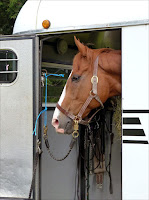 |
| Pretty chestnut, just waiting... |

Enjoy my article about hunter paces and turkey trots, a piece beautifully designed by the magazine for your reading pleasure.
July 7, 2015
Mystic Valley Hunt Club – A Treasure in Southeastern Connecticut
by Toni Leland

Imagine riding your horse in a beautiful setting on 172 acres in Southeastern Connecticut. Better still, imagine taking lessons from Connecticut Hunter/Jumper Association’s 2014 High Point Hunter Trainer, Sally Hinkle Russell. These dreams can come true at Mystic Valley Hunt Club in Gales Ferry, a premier training facility owned and cherished by Sally.

My very first assignment for Connecticut Horse magazine! Wow, a chance to meet this charming and caring horsewoman, and see the dream she made come true.
Join me as we talk with Sally, and walk her beautiful property. Happy horses and happy riders are everywhere, and that makes Sally happy!

Connecticut Horse makes its debut with this issue. Look forward to many more issues packed with interesting and informative articles and details about horses in Connecticut.

Imagine riding your horse in a beautiful setting on 172 acres in Southeastern Connecticut. Better still, imagine taking lessons from Connecticut Hunter/Jumper Association’s 2014 High Point Hunter Trainer, Sally Hinkle Russell. These dreams can come true at Mystic Valley Hunt Club in Gales Ferry, a premier training facility owned and cherished by Sally.

My very first assignment for Connecticut Horse magazine! Wow, a chance to meet this charming and caring horsewoman, and see the dream she made come true.
Join me as we talk with Sally, and walk her beautiful property. Happy horses and happy riders are everywhere, and that makes Sally happy!

Connecticut Horse makes its debut with this issue. Look forward to many more issues packed with interesting and informative articles and details about horses in Connecticut.
June 18, 2015
Working Between Novels: Short Stories Keep the Brain Fresh
by Toni Leland
Writing "The End" to a 90,000-word novel is more than relief and celebration — there is a let-down too. After living with the characters and their dilemmas for anywhere from eight months to a year, an author can't help but find it hard to let go. Sure, once the story is done and published, the exhilaration lasts for several weeks. But then what?
Personally, I find it hard to plunge into another major project, even in a series. I need time to think about other things, but I also need to continue to write. The answer is short stories and freelance articles. These are short-term projects that keep the brain working like a finely-tuned machine and, interestingly enough, while the gray cells are focusing on the job at hand, they are also churning out deeper ideas for the next "big one."
A few years ago, I wrote several short stories for inclusion in women's magazines. One, in particular, was contracted immediately by a new romance publication; sadly, before the third issue could go to press, the magazine folded (underfunded and undersubscribed) and my story rights reverted back to me. I put it aside to await another opportunity. And forgot about it.
Cleaning up old files on the computer recently, I came across it. Read it. Still liked it. Did some fine-tuning and, as they say, the rest is history.
Second Chances debuted on Kindle this week and the process of setting the story free has recharged my batteries. I'm ready to begin work on the fifth book in my Kovak & Quaid series. Sometimes we authors just need a little break.

Writing "The End" to a 90,000-word novel is more than relief and celebration — there is a let-down too. After living with the characters and their dilemmas for anywhere from eight months to a year, an author can't help but find it hard to let go. Sure, once the story is done and published, the exhilaration lasts for several weeks. But then what?
Personally, I find it hard to plunge into another major project, even in a series. I need time to think about other things, but I also need to continue to write. The answer is short stories and freelance articles. These are short-term projects that keep the brain working like a finely-tuned machine and, interestingly enough, while the gray cells are focusing on the job at hand, they are also churning out deeper ideas for the next "big one."
A few years ago, I wrote several short stories for inclusion in women's magazines. One, in particular, was contracted immediately by a new romance publication; sadly, before the third issue could go to press, the magazine folded (underfunded and undersubscribed) and my story rights reverted back to me. I put it aside to await another opportunity. And forgot about it.
Cleaning up old files on the computer recently, I came across it. Read it. Still liked it. Did some fine-tuning and, as they say, the rest is history.
Second Chances debuted on Kindle this week and the process of setting the story free has recharged my batteries. I'm ready to begin work on the fifth book in my Kovak & Quaid series. Sometimes we authors just need a little break.

April 5, 2015
RISKY BUSINESS – the Kovak & Quaid Mystery Series Continues
 I'm always thrilled to announce that I've finished a book, but I'm particularly happy with the release of RISKY BUSINESS. Why? Because writing a series is not for the faint of heart!
I never dreamed when I started that something that seemed so simple could be so challenging. I mean, how hard is it to write stories in the same setting with the same people? I discovered that keeping everything straight for myself and my readers, as well as keeping my readers engaged with the characters for the long-term was not that easy.
So, I offer you Book 4 of the series and hope that you will enjoy reading it as much as I enjoyed writing it. Kovak & Quaid thank you!
~ Toni Leland
Risky Business releases April 20, 2015
July 10, 2012
Writing Using the Five Senses
by Toni Leland
I have many passions: writing, music, photography, family, and gardening. In fact, my love of the outdoors and digging in the earth has served me well with my writing.
Passionate writing is something the world longs for, the driving force behind every book sale, or check-out at the library, or Internet download. To immerse oneself in the world of another is the salve for a troubled or weary mind.
So how do I relate my garden experience to my writing? Five senses—we all have them, we all use them—but do we employ them in our work? In the garden, these senses are obvious: seeing, hearing, smelling, touching, tasting. Each of them can be integrated into any work of fiction or non-fiction, enlarging the reader's view of your imaginary or real world.
Sight: from the whole of a garden landscape to the integral parts of a rose bed
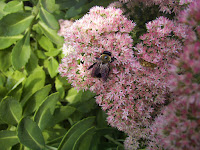 to the minute features of a dragonfly perched on a leaf, these details imprint our brain with an everlasting image. In your writing, incorporate details into the setting, gradually parceling it out over the first couple of chapters. Include how the first sight of something makes you feel. Refrain from spending two consecutive pages describing the scene; less at a time is better.
Sound: in spring, the woodland peeper frogs raise a din that stops one in their tracks. Bird conversations and song, the buzz of winged insects, the chatter of squirrels. In prose, find ways to liken your story sounds to something that brings an instant visual to the mind.
Smell: a Casa Blanca Lily fills the dusk air with a scent so heady that one must stop to inhale several times. Brush past a Scented Geranium and delight in the pungent mint, lemon, or musk fragrance that floats on the air and clings to your clothes. Including a sense of smell in your writing can be more challenging than some of the other senses.
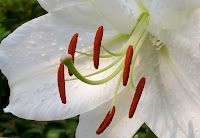
The word "smell" is both a verb and a noun: to smell a rose, or ask "what is that smell?" Use the word sparingly; others are more descriptive and appropriate: "fragrance" is used to convey something pleasant; "scent" can be pleasant or intriguing or mysterious. Add adjectives or adverbs to clarify the description; i.e., the heady fragrance; a manly scent. The word "odor" is almost without exception used to describe something unpleasant. You wouldn't say, "the odor of her perfume," but you would say, "the odor of the outhouse."
Touch: in my garden, I delight in the texture of soft, velvety Lambs Ears and the fernlike feel of a Japanese Laceleaf Maple. I'm careful to avoid the sting of thorns on the rosebushes and barberry, but love the feel of soft, warm earth sieving through my fingers. Touch is one of the easiest senses to convey in writing. Touch things in your environment or home, then write down the sensations they convey and liken them to something universally recognized. A soft chenille lap-robe might remind you of the fur on a rabbit or fluffy cat. Carrying the idea further, but without the hands-on research, consider the still, cold flesh of a dead body. Would it remind you of marble? Or wax?
Taste: ripe tomatoes warmed by the afternoon sun, or the tiny drop of nectar
 from a honeysuckle blossom, or the burst of heat from a spearmint leaf. Including taste in your writing is probably one of the toughest challenges unless you are writing about food or intimacy (clearly, no one tastes a piano or automobile), but see if you can find ways to incorporate this sense into your story. Describe how a kiss tastes, or a sip of wine, or a drink of water fresh from a mountain spring, or a crunchy apple, or a bit of grit on your tongue. Describe not only the physical sensation of the flavor, but the mental sensation the taste evokes.
Writing Prompt: Randomly choose any object, then apply all five senses and write a description of each. With a little practice, you can integrate the five senses into your writing.
I have many passions: writing, music, photography, family, and gardening. In fact, my love of the outdoors and digging in the earth has served me well with my writing.
Passionate writing is something the world longs for, the driving force behind every book sale, or check-out at the library, or Internet download. To immerse oneself in the world of another is the salve for a troubled or weary mind.
So how do I relate my garden experience to my writing? Five senses—we all have them, we all use them—but do we employ them in our work? In the garden, these senses are obvious: seeing, hearing, smelling, touching, tasting. Each of them can be integrated into any work of fiction or non-fiction, enlarging the reader's view of your imaginary or real world.
Sight: from the whole of a garden landscape to the integral parts of a rose bed

Sound: in spring, the woodland peeper frogs raise a din that stops one in their tracks. Bird conversations and song, the buzz of winged insects, the chatter of squirrels. In prose, find ways to liken your story sounds to something that brings an instant visual to the mind.
Smell: a Casa Blanca Lily fills the dusk air with a scent so heady that one must stop to inhale several times. Brush past a Scented Geranium and delight in the pungent mint, lemon, or musk fragrance that floats on the air and clings to your clothes. Including a sense of smell in your writing can be more challenging than some of the other senses.

The word "smell" is both a verb and a noun: to smell a rose, or ask "what is that smell?" Use the word sparingly; others are more descriptive and appropriate: "fragrance" is used to convey something pleasant; "scent" can be pleasant or intriguing or mysterious. Add adjectives or adverbs to clarify the description; i.e., the heady fragrance; a manly scent. The word "odor" is almost without exception used to describe something unpleasant. You wouldn't say, "the odor of her perfume," but you would say, "the odor of the outhouse."
Touch: in my garden, I delight in the texture of soft, velvety Lambs Ears and the fernlike feel of a Japanese Laceleaf Maple. I'm careful to avoid the sting of thorns on the rosebushes and barberry, but love the feel of soft, warm earth sieving through my fingers. Touch is one of the easiest senses to convey in writing. Touch things in your environment or home, then write down the sensations they convey and liken them to something universally recognized. A soft chenille lap-robe might remind you of the fur on a rabbit or fluffy cat. Carrying the idea further, but without the hands-on research, consider the still, cold flesh of a dead body. Would it remind you of marble? Or wax?
Taste: ripe tomatoes warmed by the afternoon sun, or the tiny drop of nectar

Writing Prompt: Randomly choose any object, then apply all five senses and write a description of each. With a little practice, you can integrate the five senses into your writing.
February 7, 2011
Is Self Publishing the Easy Way Out?

Never let anyone tell you that publishing your own book is an easy way to do it, or a "last resort". Self-publishing is anything but easy and, in today's publishing economy, "last resort" could be "only resort."
In a post last month, I asked if writers knew if their book was ready to see print, whether traditional or not. Following my own advice, I just finished reading through my "finished" YA manuscript for the SIXTH time. Yes, I wanted to skip this last read--I'm really tired of the story. But knowing that any time an author touches a manuscript, even to adjust a word, or change a line, that action provides the opportunity to mess it up!
Yes, I found seven typos.
Writers have access to a ton of good, expert advice, so why not take advantage of it? The hard work that writing and getting published entails is certainly made easier by solid, dependable information.
I subscribe to the Author Marketing Experts newsletter, a marvelous goodie basket of advice and tips for anyone trying to sell books--self-published or not. Penny Sansivieri wrote a great article last week about self-publishing and protecting oneself from getting scammed. She offers 13 tips for protecting yourself.
For example: " #4--Promises, promises: don't believe the hype. Yes, we are all selling services, but there is only so much that a publisher can promise you. They can promise you a finished book. Beyond that, it's a lot of hard work and a little luck."
Well said! Read the whole article HERE. Better yet, check out the website and FaceBook. Sign up for the newsletter.
You won't be sorry.
Author Marketing Experts
AME on Facebook
January 11, 2011
Freelance Writing
 |
| Jeff Geerling photo |
Not only would I continue to work hard for the publications that have supported me in the past, I would spend some time each week acquainting myself with new possibilities. Sitting down and researching publications and their needs, wants, policies, and compensations is by no means a quick or simple task. But it is a very necessary one for any writer who wishes to build a foundation for their work.
The key to finding your assignments is clarifying to yourself where your strongest writing lies, then pursuing those publications that cater to your subject. Tempting as it might be to try something new, you'd be best served to stick with what you know and can manage easily. Organize the publications according to the type of submission they require; i.e., do they insist on snail mail? Will they take phone pitches? Do they have an upload feature for submitting? Categorizing them in this way will allow you to use your time and energy efficiently. Choose a day for putting together only the mail submissions, then choose another day to query or submit via e-mail. (I find that switching from physical to electronic and back to physical can get confusing.)
Whether you write short content for blogs and online sites, columns or essays, or longer feature articles, it's important to have a structure to your work plan. Today's technology can provide you with anything you need, many times for very little cost.
One of my latest "finds" is a wonderful tool called Writer's Scribe. I tried out the Mac version demo, loved it, and it now is comfortably settled on my computer, helping me stay organized and ahead of the game. With over 125 feature-length articles in my portfolio, I can no longer keep track of them using file folders.
From time to time, I'll be sharing some of my past articles, and I hope to feature some guest writers here on the Musings page. If you've discovered a wonderful writing tool that will help make this year more productive, please share it with us. We all need to succeed!
Subscribe to:
Posts (Atom)